Conditions / TMJ disorders
TMJ disorders
Temporomandibular joint (TMJ) disorders — jaw pain, clicking, limited opening, locking — often have a muscle and posture component that can be addressed.
Reviewed by Gina Sabbak, RDH · Myofunctional Therapist, Louisville KY. Last reviewed . Educational content — not a substitute for in-person evaluation.
What it is
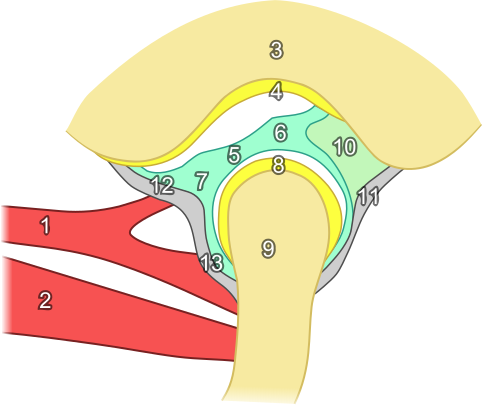
The TMJ is the hinge connecting the jaw to the skull. Disorders can involve the joint itself, the disc inside it, or the muscles that move it. Tongue posture and clenching habits are often overlooked contributors.
TMJ disorders are typically managed by a dentist or oral surgeon; myofunctional therapy complements that work.
Common signs
- Jaw pain or soreness, especially on waking
- Clicking, popping, or grating in the jaw joint
- Limited jaw opening or locking
- Frequent headaches or neck pain
- Clenching or grinding (day or night)
How myofunctional therapy may help
Educational, not diagnostic. Outcomes vary; results are not guaranteed.
Retrain the tongue to rest in the high posture that supports, rather than loads, the jaw.
Address day-time clenching and night-time grinding habits.
Improve head and neck posture that affects jaw loading.
What to expect
A typical program runs 3–6 months.
Most people see reduced pain and clicking within the first 6–8 weeks.
Coordinated care with your dentist or oral surgeon is essential.
Keep learning
Related reading
- What is myofunctional therapy, really?
Educational article (~5 min read).
- Customized Exercise Programs
How this service supports this condition.
- All conditions we work with
The full set of myofunctional patterns we support.
- How we may help
Overview of the assessment and program structure.
Common questions about tmj disorders
- Can myofunctional therapy help with TMJ pain?
- Myofunctional therapy can help with the muscle and posture side of TMJ disorders — for example, by addressing daytime clenching, low tongue posture, and forward head posture, all of which can load the jaw. It is not a treatment for the joint itself when there is internal derangement or structural change. For that reason, myofunctional therapy for TMJ is most effective as part of a coordinated plan with your dentist or oral surgeon.
- What is the connection between tongue posture and jaw pain?
- When the tongue rests low in the mouth instead of gently against the palate, the jaw is not supported from above. Other muscles — including the chewing muscles and the muscles under the chin — pick up the load. Over time, this contributes to soreness, tension, and habits like clenching. Establishing correct tongue-up rest posture is one of the foundations of TMJ-focused therapy.
- Is TMJ disorder something I should see a dentist for first?
- Often yes. TMJ disorders are typically diagnosed and managed by a dentist, oral surgeon, or other specialist who can evaluate the joint itself, the disc inside it, and whether there is structural change. Myofunctional therapy complements that work — we address the muscle and posture side. If you are unsure where to start, a comprehensive myofunctional evaluation (/services#myofunctional-evaluations) can help clarify which direction to go first.
Open references
Where the illustrations come from
The anatomical illustrations on this page are drawn from openly licensed educational sources. We attribute them in the caption; the canonical sources are linked here for anyone who wants to verify or use them.